Most people believe that effective training requires a ₹2,000/month gym membership, a rack of dumbbells, and at least an hour of daily commuting to get there and back. This belief stops more people from training consistently than almost anything else. And it is wrong.
Your bodyweight is all the resistance your muscles need for a genuinely challenging, productive workout — especially in the first 6–12 months of consistent training. Gravity does not care whether you are in a ₹5,000/month premium gym or your living room at 6 AM before your family wakes up.
This specific 30-minute routine was designed by Trainer Anil for busy professionals — people with real schedules, small homes, and no time for the gym. It is structured, progressive, and built on the same principles that govern effective training anywhere: mechanical tension, metabolic stress, and progressive overload applied consistently over time.
Clients who used this routine before transitioning to gym training had significantly better body awareness, movement quality, and baseline fitness than people who started in the gym directly. Home training is not a compromise — it is a legitimate foundation.
Why Home Workouts Actually Work
Muscles respond to one thing: mechanical tension — the force placed on muscle fibres during a contraction. A muscle does not know whether that tension comes from a 20kg barbell or from resisting your own bodyweight through a range of motion. What matters is that the muscle is loaded close to its capacity.
But the most important variable in any training programme is not the equipment. It is consistency. A workout you actually do three times a week beats the "optimal" gym programme you attend twice a month. The gym you skip is worthless. The living room workout you do every Monday, Wednesday, and Friday produces real, visible results over 6 months.
A 2023 meta-analysis found that home-based resistance training produces 90% of the muscle gains of gym-based training when matched for volume and intensity. The 10% difference is real but small — and it is more than offset by the consistency gains that come from removing the friction of commuting.
Home training also eliminates gym anxiety — a genuine barrier for many beginners who feel self-conscious training around experienced gym-goers. Your living room has no mirrors pointing at you from the wrong angle and no one watching your form. That matters for adherence in the first 3 months when habits are forming.
The Science: Bodyweight vs Weights
Muscle growth is driven by two primary mechanisms: mechanical tension (the physical load on muscle fibres) and metabolic stress (the accumulation of metabolites during high-rep, short-rest training). Both are fully achievable without external weights.
The key insight from resistance training research is this: taking a set close to muscular failure produces the same hypertrophic stimulus regardless of the absolute weight used. Three reps of a very heavy exercise and thirty reps of a lighter exercise, when both are taken to within 1–3 reps of failure, produce similar amounts of muscle growth. What matters is the proximity to failure — not the weight on the bar.
| Aspect | Home Bodyweight | Gym Weights |
|---|---|---|
| Cost | Free | ₹1,500–3,000/month |
| Convenience | Maximum | Moderate |
| Equipment needed | None | Yes |
| Beginner-friendly | Very | Moderate |
| Progressive overload | Limited long-term | Unlimited |
| Best for | Beginners, maintenance, fat loss | Advanced strength and mass |
| Injury risk | Lower | Moderate |
The honest limitation of bodyweight training is progressive overload over the long term. After 12+ months of consistent bodyweight training, you will have exhausted many of the simple progression methods (more reps, slower tempo, harder variations) and need external load to continue driving strength and muscle gains meaningfully. But that is a problem for month 13. In months 1–12, bodyweight training is fully adequate.
The 5-Minute Warm-Up
Never skip the warm-up. Cold muscles are significantly more injury-prone, and a cold nervous system produces weaker, less coordinated movement. Five minutes of dynamic movement prepares your joints, raises your core temperature, and activates the neuromuscular pathways you are about to use.
-
1
Arm Circles
30 seconds forward, 30 seconds backward. Full range of motion — large circles that mobilise the shoulder joint completely. Loosens the rotator cuff before push-up and dip work.
-
2
Hip Circles
20 circles each direction. Hands on hips, draw the largest circle you can with your hips. Mobilises hip flexors and the lumbar spine before squat and lunge work.
-
3
Leg Swings
15 swings each leg, front-to-back and lateral. Stand beside a wall for balance. Dynamic hamstring and hip flexor mobilisation — critical before lunges and squats.
-
4
High Knees in Place
45 seconds at moderate pace. Drives heart rate up, warms the hip flexors, and begins activating the core. This is where the light sweat starts — that is the target.
-
5
Dynamic Chest Opener
30 seconds. Arms extended out to the sides, actively pull them back to open the chest, then bring them forward. Prepares the chest and anterior shoulder for push-up work.
-
6
Jumping Jacks
45 seconds at a moderate pace to finish the warm-up. Full body elevation of heart rate and core temperature — you should feel warm and ready by the end of these.
The 20-Minute Main Circuit
The circuit is divided into two parts: Circuit A (strength) and Circuit B (core). Complete 3 rounds of Circuit A with 60 seconds rest between rounds, then immediately move to Circuit B without extended rest. Total time: approximately 20 minutes.
Circuit A — Strength (3 Rounds, 10–12 minutes)
-
A1
Push-Ups — 3 sets × 12–15 reps
Form: Hands shoulder-width apart, body in a straight line from heels to head. Lower your chest to within 2cm of the floor. Elbows at 45° to your torso — not flaring out at 90°.
Beginner: Knee push-ups — same form, just drop to your knees. Advanced: Decline push-ups — feet elevated on a chair to load the upper chest and shoulders more. -
A2
Bodyweight Squats — 3 sets × 15–20 reps
Form: Feet shoulder-width apart, toes pointed out 20°. Arms extended forward for counterbalance. Descend until your hip crease is below your knee — a parallel squat minimum. Keep your chest up and your knees tracking over your toes.
Beginner: Chair-assisted — squat to a chair seat and stand back up. Advanced: Jump squats — add an explosive jump at the top of each rep. -
A3
Mountain Climbers — 3 sets × 20 reps each leg
Form: Start in a high plank position — hands under shoulders, body straight. Drive one knee toward your chest, then drive it back while immediately driving the other. Core tight throughout — do not let your hips rise or drop. This is both a core exercise and cardiovascular work.
Beginner: Slow, controlled pace — bring one knee fully in before starting the other. Advanced: Sprint speed — fast alternating drive for 20 seconds. -
A4
Chair Dips (Triceps) — 3 sets × 10–12 reps
Form: Sit on the edge of a sturdy chair. Place your hands on the chair edge beside your hips, fingers forward. Walk your feet out and lower your body by bending your elbows to 90°. Press back up through your triceps — not your legs. Keep your back close to the chair.
This is the best tricep exercise available without equipment. It also builds significant shoulder stability. -
A5
Reverse Lunges — 3 sets × 10 reps each leg
Form: Stand tall, then step backward with one foot — lower your back knee to within 2cm of the floor. Your front shin should be vertical. Drive back up through the heel of your front foot. Alternate legs or complete all reps on one side before switching.
Reverse lunges are significantly easier on the knee than forward lunges, making them the better default for home training. They load the glute and quad equally.
Each round takes approximately 3–4 minutes to complete (including brief rest between exercises). With 60 seconds rest between rounds, 3 rounds of Circuit A takes roughly 10–12 minutes. Move directly into Circuit B.
Circuit B — Core (1 Round, 8 minutes)
-
B1
Plank — 3 sets × 30–60 seconds
Forearms on the floor, elbows under shoulders, body in a straight line. Squeeze your glutes, brace your abs as if expecting a punch, and breathe steadily. Do not let your hips drop or rise. Start at 30 seconds and work toward 60 seconds over weeks.
-
B2
Bicycle Crunches — 3 sets × 15 each side
Lying on your back, hands behind your head (not pulling your neck). Bring one knee toward your chest while rotating your opposite elbow toward it. Extend the other leg fully. The key is rotation — your shoulder, not just your elbow, should move toward the knee. Full extension of each leg is what makes this exercise challenging.
-
B3
Glute Bridges — 3 sets × 15 reps (2-second pause at top)
Lying on your back, knees bent, feet flat on the floor hip-width apart. Drive through your heels to lift your hips until your body forms a straight line from knees to shoulders. Pause for 2 full seconds at the top — squeeze your glutes hard. Lower with control. The 2-second pause removes momentum and forces the glute to hold under tension.
-
B4
Superman Holds — 3 sets × 10 reps (3-second hold each)
Lying face down on the floor, arms extended above your head. Simultaneously lift your arms, chest, and legs off the floor by squeezing your lower back and glutes. Hold for 3 seconds at the top. Lower with control. This is one of the only exercises in this routine that directly trains the lower back — an often neglected but critical muscle group for posture and injury prevention.
-
B5
Side Plank — 2 sets × 20–30 seconds each side
Forearm on the floor, elbow under shoulder. Stack your feet or stagger them for more stability. Body forms a straight lateral line from ear to ankle. Keep your hips lifted — the tendency is to let the lower hip sag. This trains the obliques and the lateral core stabilisers that standard planks do not reach.
Trainer Anil offers in-home sessions with portable equipment and a full progressive programme tailored to your space and schedule.
The 5-Minute Cool-Down
The cool-down is not optional. After 20 minutes of high-intensity circuit work, your heart rate and core temperature are elevated. Abruptly stopping causes blood to pool in your extremities and can cause dizziness or light-headedness. The cool-down also begins the recovery process — stretching warm muscles when they are most pliable is when flexibility work has the greatest effect.
- Child's Pose — 45 seconds. Kneel and fold forward, arms extended. Stretches hip flexors, lower back, and the thoracic spine all simultaneously. Breathe deeply into your lower back.
- Chest Stretch (arm against wall) — 30 seconds each side. Place your forearm against a door frame or wall at 90°, then gently rotate your body away from it. Stretches the chest and anterior shoulder that did the push-up and dip work.
- Seated Hamstring Stretch — 45 seconds each side. Sit on the floor, one leg extended, one leg bent. Reach toward the toes of your extended leg with a straight back — hinge from the hips, not the lower back.
- Hip Flexor Lunge Stretch — 30 seconds each side. Step one foot forward into a lunge position, drop the back knee to the floor. Push your hips forward gently until you feel a stretch through the front of the back hip. Critical after squat and lunge work.
- Deep Breathing — 5 slow breaths. Sit or lie down comfortably. Inhale for 4 seconds, exhale for 6 seconds. The longer exhale activates the parasympathetic nervous system — your body's rest-and-recover mode. This is how you end a training session.
How to Progress Week By Week
Progressive overload is the most important principle in resistance training. Without it, your body adapts to the current stimulus and stops changing. Here is a systematic 12-week progression plan for this routine.
Weeks 1–2: Form Foundation
Learn correct form for every exercise before increasing difficulty. Use beginner modifications where needed. Focus on control through the full range of motion — quality over speed. Your goal is to complete all sets without form breakdown.
Weeks 3–4: Add Volume
Add 2–3 reps to each exercise from the week 1–2 baseline. Standard tempo — one second up, one second down. Rest 60 seconds between Circuit A rounds.
Weeks 5–6: Slow the Eccentric
Slow down the eccentric (lowering) phase of each exercise to 3 seconds. Lower into a push-up over 3 seconds, lower into a squat over 3 seconds. Removing momentum dramatically increases difficulty without changing the exercise. Expect your rep counts to drop — that is expected and correct.
Weeks 7–8: Harder Variations
Progress to more challenging variations: decline push-ups, jump squats at the end of squat sets, faster mountain climbers. The exercise stays the same — the variation increases the load.
Weeks 9–10: Reduce Rest
Reduce rest between Circuit A rounds from 60 seconds to 40 seconds. The same work in less time = greater density = more metabolic stress = more adaptation.
Weeks 11–12: Add a Fourth Round
Add a 4th round of Circuit A. This increases total training volume by 33%. Consider adding a light resistance band (₹200–500 from any sports shop) around your thighs during squats and glute bridges for additional resistance.
Advanced Modifications
Once the standard exercises become manageable (you can hit the top of the rep range with 2–3 reps still in the tank), it is time to progress to harder variations. These keep the workout challenging after the first few months without any equipment.
The hardest bodyweight exercise is the one you can only do 3–5 reps of. When you can comfortably do 15 reps, that exercise is no longer providing significant training stimulus. Always be training near failure — not through pain, but through genuine muscular effort.
-
Push-Up Progression
Standard Push-Up → Decline Push-Up (feet elevated, more upper chest) → Archer Push-Up (one arm extended fully out to the side while you lower) → One-Arm Push-Up progression (start with hand on an elevated surface to reduce load on the working arm). Each variation significantly increases difficulty.
-
Squat Progression
Bodyweight Squat → Jump Squat (explosive power, cardiovascular load) → Bulgarian Split Squat (rear foot elevated on a chair behind you — this is genuinely difficult and rivals the barbell squat for glute and quad development) → Pistol Squat progression (single-leg squat — start holding onto a door frame for assistance).
-
Plank Progression
Standard Plank → RKC Plank (same position, but actively drag your elbows toward your feet and your feet toward your elbows — creates full-body tension throughout, dramatically harder) → One-Arm Plank (maintain position with one arm lifted).
-
Chair Dip Progression
Standard Chair Dips → Weighted Dips (place a heavy bag on your lap) → Parallel Dip using two sturdy chairs or the edge of a kitchen countertop. As you get stronger, the parallel dip becomes a genuine triceps and chest mass builder.
When Do You Actually Need a Gym?
Honesty matters here. Home training has genuine limitations over the long term. Here is a clear-eyed assessment of when gym access adds real value that home training cannot replicate.
For the first 6–12 months of consistent training, a well-designed home workout can match gym results for most people. After that, gym access starts to add meaningful value — particularly for progressive overload with external load and isolation work for weak points.
After 12+ months of consistent home training, here is what gym access specifically adds:
- Unlimited progressive overload. Barbells and weight plates allow you to add 2.5kg every week for years. Bodyweight variations eventually run out of meaningful progressions without equipment.
- Isolation machines for weak points. Leg press, cable rows, lat pulldowns, and chest cable work allow you to address specific lagging muscle groups with precision that bodyweight training cannot match.
- Social accountability and environment. Seeing other people train consistently is a powerful motivator. The gym environment — other people working hard, a dedicated training space — affects effort levels.
- Professional coaching access. Gym environments make it easier to work with a trainer regularly and get real-time form correction.
Trainer Anil offers in-home training sessions — he comes to your home with portable resistance equipment (bands, suspension trainers, kettlebells) and teaches proper form in your own environment. This is particularly suitable for beginners, parents with young children, and professionals with irregular schedules who cannot commit to gym timings.
Key Takeaways
- A 30-minute bodyweight circuit can produce real, visible muscle and fat loss results — especially in the first 6–12 months of training.
- Research confirms bodyweight training taken close to failure produces 90% of gym-based muscle gains when matched for volume and intensity.
- Progressive overload applies to home training: more reps → harder variations → slower eccentric → less rest → add a round.
- Consistency beats optimality. The home workout you do 3× per week beats the "perfect" gym programme you attend twice a month.
- After 6–12 months of consistent training, gym access adds meaningful value for advanced progressive overload — but it is a supplement to, not a replacement for, the foundation you build at home.
- The warm-up and cool-down are not optional. Injury prevention and recovery start before and after the main circuit.
Frequently Asked Questions
Yes — especially for beginners and intermediate exercisers, which is most people reading this. The push-up, squat, reverse lunge, chair dip, and glute bridge are compound movements that load large muscle groups. Performed progressively — adding reps, slowing the tempo, progressing to harder variations — these movements build real muscle. The visible change in body composition after 6 months of consistent training, combined with adequate protein intake, will genuinely surprise you. The muscle you build creates the "toned" look that most people are actually after.
3–4 times per week with at least one rest day between sessions. A practical schedule: Monday, Wednesday, Friday, and optionally Saturday. On rest days, a 30-minute brisk walk is ideal — it aids recovery by increasing blood flow without adding training stress. Avoid training 7 days a week with this routine. Muscle growth happens during recovery, not during the workout itself. Rest days are when the results are actually built.
Change one variable at a time: the order of exercises, the tempo, the rest periods, or the variations. You can also structure weeks as themed training days — a push-focused day (push-ups, dips, decline push-ups), a pull-focused day (reverse rows under a table, superman holds, band pull-aparts), and a legs-and-core day (squats, lunges, glute bridges, planks). Trainer Anil's home training clients receive a rotating programme that changes every 4 weeks — same fundamental movements, different structure, different variations — which prevents both mental boredom and physical plateau.
Exercise alone produces modest fat loss — approximately 0.1–0.2 kg per week if the workout is consistent and intense. For significant body composition change, diet accounts for 70–80% of the result. A home workout routine combined with a moderate calorie deficit (eating 400–500 kcal less than you burn daily) and adequate protein (1.6–2g per kg of bodyweight) produces dramatic results over 3–6 months. The workout preserves and builds muscle; the diet creates the conditions for fat loss. They work together — neither alone produces optimal results.
About Trainer Anil
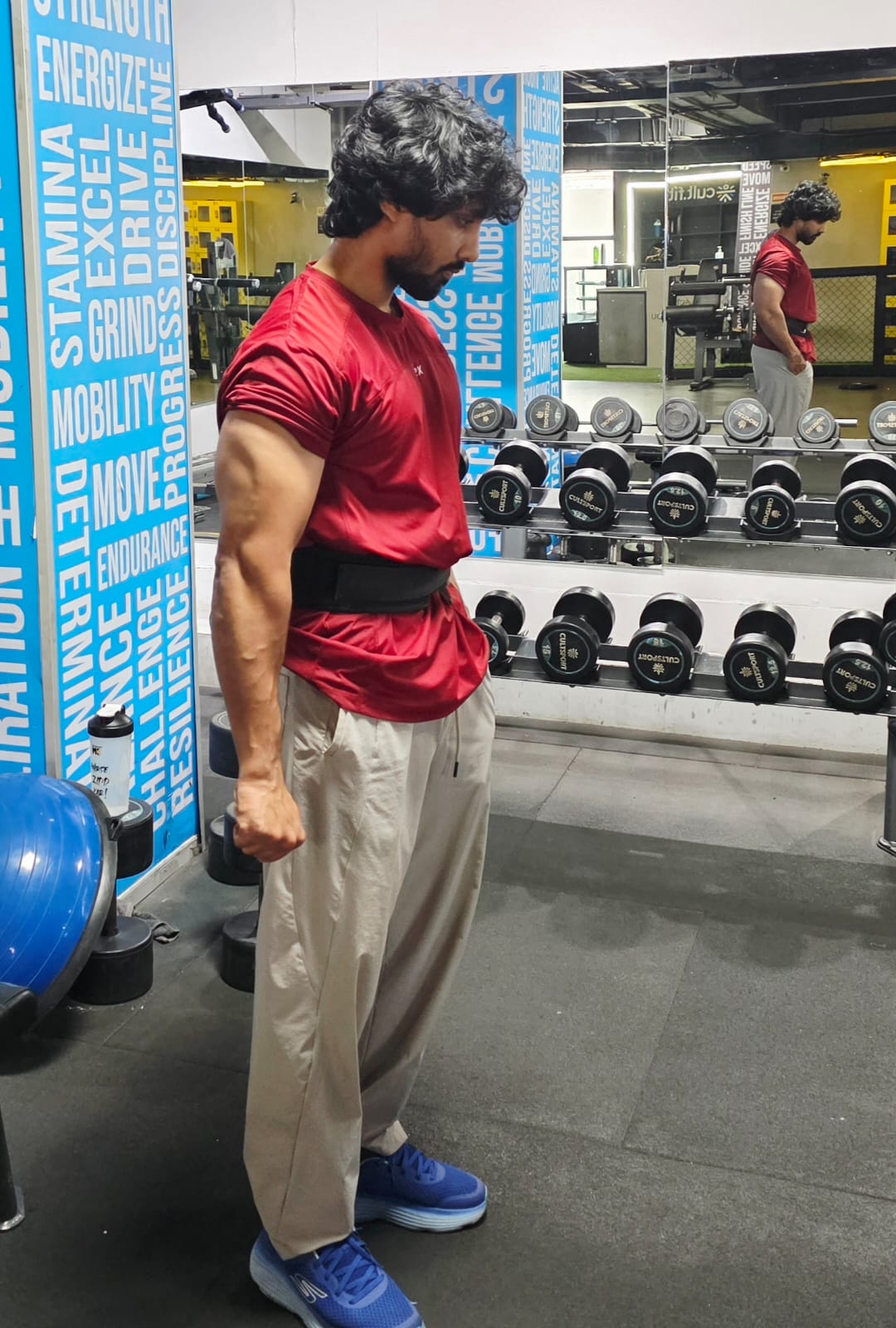
Anil is a certified personal trainer with 325+ client transformations across India. He specialises in making fitness work for people with real lives — busy professionals, parents, and beginners who cannot commit to a gym schedule. He offers home training sessions with portable equipment, online coaching, and gym-based programmes, all designed around real Indian schedules and diets.
Start Training at Home with Expert Guidance
Trainer Anil will come to your home with equipment and build a progressive programme around your space, schedule, and goals. No gym required. Real results guaranteed.